
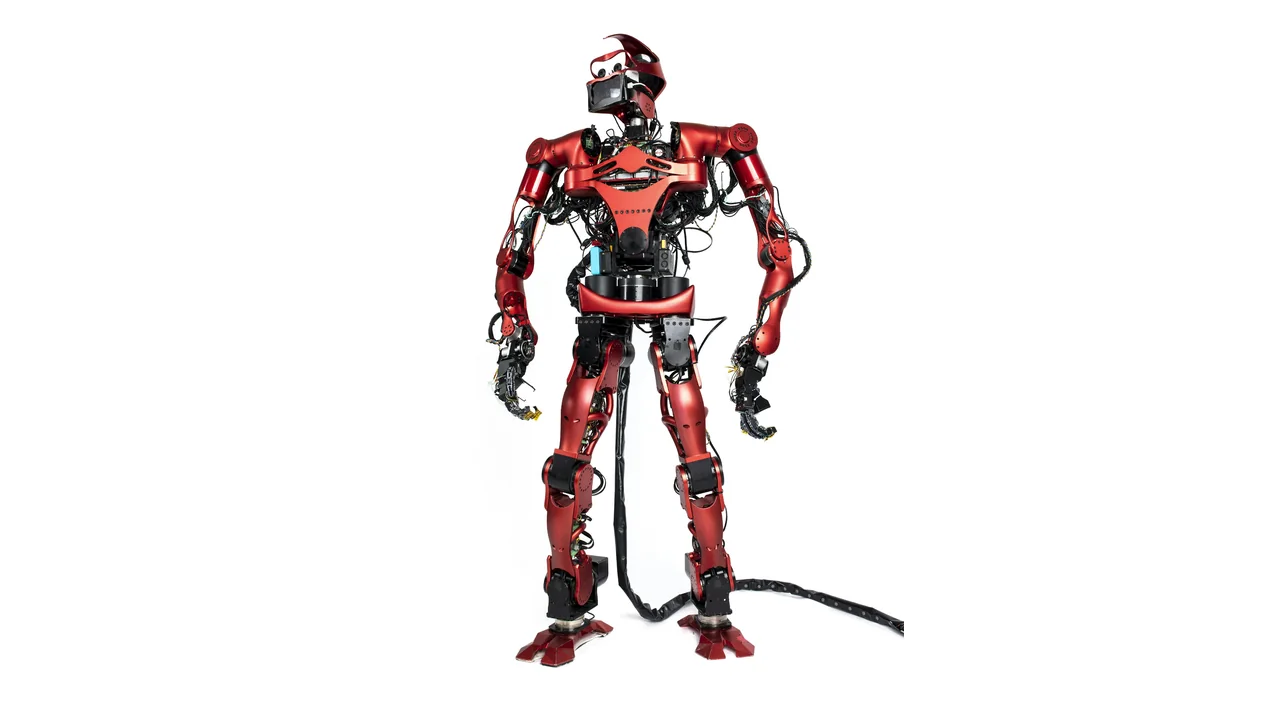
Follow a robot from simulated falls to careful real-world steps, where mechanics matters as much as software.
A robot takes one careful step onto a stone. Its knee bends, the body tilts, and the other foot moves just enough to catch its weight. It looks simple until you try to explain every adjustment required to keep it upright.
Walking is not a sequence of poses played like a slide show. It is a continuing exchange between a body and the ground. Contact, momentum, balance and timing all change as the robot moves. A small error can grow into a fall before the next planned step finishes.
Learning-based control offers ways to build walking behaviour from experience. It has produced impressive research demonstrations, but understanding the process also shows why a short video is not proof of a robot that can handle every pavement.
The body is part of the intelligence
A walking controller receives measurements such as joint positions, joint velocities and body motion. Depending on the design, it may also use cameras, force sensors or other information. It produces commands that ultimately influence motors.
The same controller cannot simply be copied from any robot to any other. Mass distribution, leg length, joint limits and actuator behaviour shape what movements are possible. Shoes matter to a human walker; contact materials and foot design matter to a robot.
Think of balancing a broom and balancing a short pencil. The general goal is similar, but the timing and corrections differ. A robot’s control problem depends on the mechanics of the actual machine, not just the cleverness of the software.
Traditional control still has a place
Engineers can design controllers using physical models and explicit rules. These methods can be effective, interpretable and appropriate for a particular machine. Learning is not a requirement for every successful robot.
Learning-based approaches instead fit some or all of the control behaviour from data or interaction. Systems can also combine methods: a learned policy might choose target motions while a conventional controller handles lower-level commands.
The useful question is which arrangement meets the task’s requirements. A robot carrying equipment over a predictable factory floor faces a different problem from one exploring loose gravel. Neither becomes easier just because we call the machine humanoid.
Simulation provides a practice ground
Training directly on hardware can wear out motors and break parts. A physics simulator lets researchers run repeated trials and reset after falls. Thousands of virtual robots can practise different conditions in parallel.
Learning to Walk in Minutes studied massively parallel reinforcement learning for the quadrupedal ANYmal robot. It is evidence for a specific training approach on a four-legged platform, rather than a claim that all robots learn human walking within minutes.
Imagine a flight simulator for balance. The virtual practice is useful because mistakes are cheaper. Yet a simulator is still a model of reality. If it gets the motor response or floor friction wrong, a successful virtual movement may fail on the real machine.
The reward shapes the gait
A reinforcement-learning policy can be rewarded for following a requested velocity, maintaining balance and avoiding excessive effort. Penalties may discourage falls, jerky movements or other unwanted behaviour.
Choosing those terms requires care. A reward for moving quickly might encourage unstable motion. A strong penalty for using energy could encourage the robot to stand still. A gait that scores well can also exploit unrealistic features of the simulator.
Watching the movement matters. So does testing different speeds, turns and surfaces. One straight-line success tells us little about stopping beside a person or recovering after an unexpected nudge. The policy needs a task, and the evaluation needs to cover that task honestly.
Crossing the gap from simulation to reality
Researchers can vary simulated friction, mass, delays and other properties during training. This domain randomisation encourages a policy to cope with a range of conditions rather than depend on one perfect model.
Sim-to-Real research on quadruped locomotion also highlights the importance of modelling actuators and latency. These details sound unglamorous. They are exactly the sort of details that determine whether a foot lands where the controller expects.
For a small example, imagine practising on a rug and then stepping onto a smooth tile. You adjust almost automatically. A robot needs a controller whose tested range includes the change, or a reliable way to recognise that the situation requires a different response.
What about two legs and human-like motion?
Bipeds have fewer supporting contacts than quadrupeds during much of their movement, which makes the balance problem demanding. Research on the Berkeley Humanoid platform reports learned locomotion across outdoor terrain using a specifically designed machine and training setup.
Researchers also use human motion as a reference. Expressive Whole-Body Control combines motion imitation with learning for a humanoid system. A human recording cannot simply be replayed as motor commands: the robot’s physical capabilities differ from the person’s.
This is where “like humans” needs clarification. Do we mean the movement looks familiar, handles similar terrain, or matches human efficiency and adaptability? Those are separate ambitions. A robot may achieve one without achieving all of them.
How to watch a demonstration critically
A good video invites questions rather than ending them:
- Is the machine tethered, remotely guided, or operating with onboard sensing?
- How many attempts were made, and how often did it fall?
- Are the surface and route familiar from training?
- Does it turn, stop and recover as well as it walks forward?
- What happens near people or unexpected obstacles?
These questions do not diminish the work. They tell you what the work has established. A repeatable ten-metre walk on a challenging surface can be an excellent research result without implying a dependable household assistant.
Progress has a practical destination
Legged robots may help inspect terrain built for human movement, carry sensors or reach places where wheels struggle. Their usefulness depends on reliability, cost, battery life and safe operation as much as the appearance of a gait.
For a beginner project, simulation is a sensible starting point. Learn how body dimensions and contact settings affect balance before investing in hardware. Even a simple two-link leg reveals how much mechanics matters, and there are plenty mistakes to learn from before a motor ever turns.
Frequently asked questions
Does a walking robot need a language model?
No. Locomotion controllers can operate without language models. High-level instruction and low-level balance are different parts of a system.
Can a simulated success prove the hardware will work?
No. Transfer must be tested on the real machine under controlled conditions, including model errors and timing differences.
Will every future robot have two legs?
There is no reason to assume that. Wheels, tracks, legs and combinations suit different environments and budgets.
A step is a whole system working together
Learning to walk brings software, mechanics, sensing and experiment into the same problem. The result can look effortless precisely because so much engineering is hidden. Appreciating that hidden work makes the demonstrations more interesting, and it gives us a more realistic sense of how far each careful step actually takes us.