
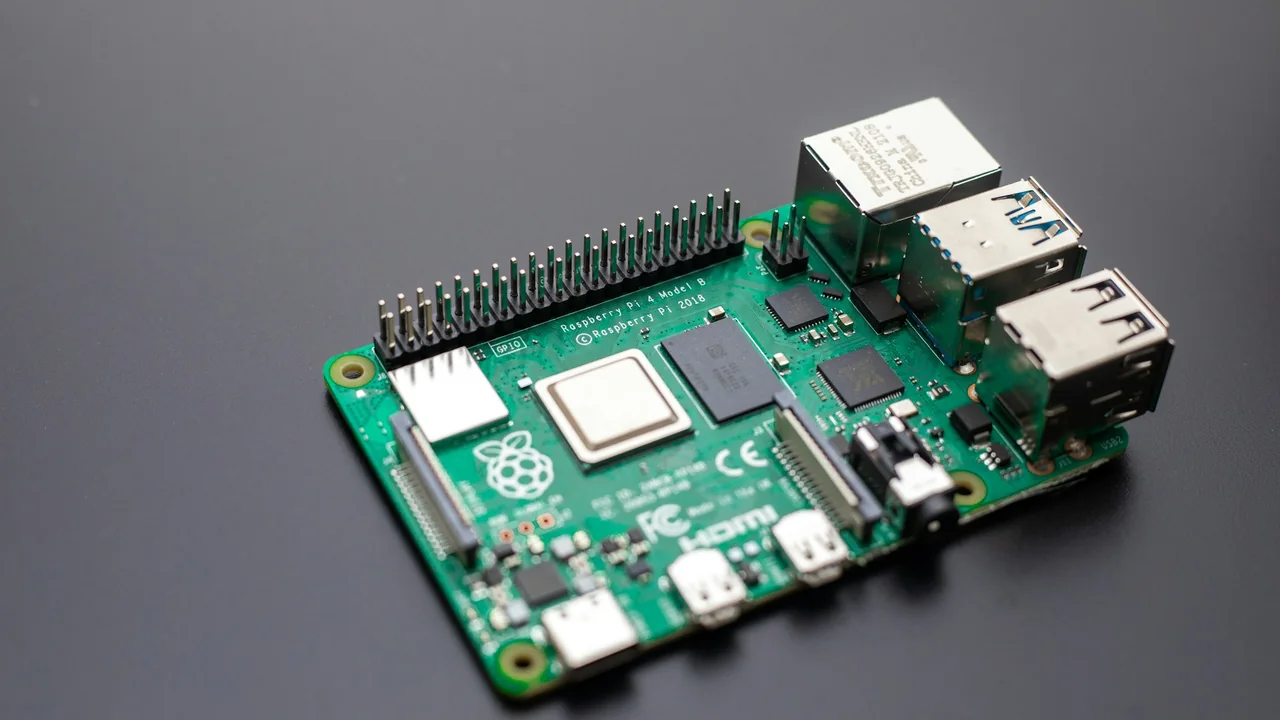
An offline field sensor explains why useful AI can be small, local and designed around real hardware limits.
A sensor in a field notices an unusual sound. The nearest internet connection is unreliable, and uploading audio all day would drain the battery. The useful question is not whether a giant model can analyse the recording somewhere far away. It is whether a small local system can notice enough to help.
That is the appeal of edge AI: running useful machine-learning inference on or near the device collecting the data. The edge might be a phone, a camera, a local computer or a tiny microcontroller. It is a location in the computing arrangement, not one particular model size.
Smaller models make some of these deployments possible. But “small” should be measured against the job, hardware and acceptable mistakes, not treated as a quality label on its own.
Keep the work close to the signal
In a cloud arrangement, a device sends information to a remote service for processing. At the edge, more of that work happens locally. Hybrid systems divide the job: a device handles routine cases and requests remote help when needed.
Think of a village shop that can answer common questions from its own stock book, calling a supplier only for unusual requests. Local knowledge saves a trip, but it has limits. The shop still needs updates and a plan for cases outside its information.
For our field sensor, a local model might detect a short pattern and save only relevant clips. That can reduce transmission. It does not automatically prove the deployment saves energy overall; the cost of continuous sensing and processing still needs measurement.
The hardware sets real limits
A tiny device has limited memory, computing capacity and power. The model must fit alongside the software that reads sensors and handles communication. Runtime memory for intermediate calculations can matter as much as the size of the saved model file.
Google’s LiteRT for Microcontrollers documentation describes running machine learning on constrained devices. Supported operations and device capabilities affect which models can run.
A phone and a small microcontroller both count as edge devices, yet their budgets are very different. A conversational language model that fits on a phone is not therefore suitable for a battery-powered temperature sensor. Comparing “edge AI” products without their hardware context can be misleading.
Quantization stores numbers more economically
A trained network uses many numerical parameters. Quantization represents values using a lower-precision format, often enabling more efficient storage and computation on suitable hardware.
Imagine reporting the distance between two nearby buildings to the nearest centimetre instead of the nearest micrometre. The coarser number may be entirely adequate for the task. But rounding becomes a problem if the decision depends on a very fine difference.
Research on integer-only inference presents a quantization approach designed for efficient execution. The practical lesson is to evaluate the converted model, not assume its behaviour is unchanged. Speed gains depend on whether the hardware and runtime actually support the chosen format efficiently.
Distillation teaches a smaller student
Knowledge distillation trains a smaller model using information from a larger model or ensemble. The original distillation paper explores transferring useful behaviour into a more manageable model.
Think of a teacher preparing focused practice material for a student. The student may learn the relevant distinctions without carrying the teacher’s entire library. The analogy should not imply a human relationship inside the system; it describes how training signals can be provided.
The result depends on the task and training material. A small model that performs well at recognising a few sound classes is not a miniature general-purpose assistant. Narrow capability can be exactly what makes it useful on a small device.
Compression has several routes and several costs
Other approaches remove less useful parameters, redesign the architecture, or exploit efficient mathematical structure. A survey of model compression describes several families of techniques.
The engineering question is the complete tradeoff. Does the model fit? Does it respond soon enough? How does its accuracy change? Can the device operate through a hot afternoon without exhausting its battery?
Our field sensor might tolerate missing an occasional ordinary background sound but require a low false-alarm rate for a costly maintenance visit. A developer should evaluate those cases explicitly. A benchmark measured on a laptop does not tell us how the actual enclosure, microphone and power supply behave outdoors.
Local processing can help privacy
Keeping raw information on a device can reduce what must leave it. A local camera might count objects while sending only a summary. That is a meaningful design option, especially when raw images contain people or private surroundings.
However, “on-device” is not a complete privacy guarantee. Logs, backups, crash reports or optional cloud features may still transfer information. A device can also be physically lost or poorly secured.
Ask what is collected, what is retained, and what is transmitted. The answer should describe the actual data flow. A friendly phrase on the packaging cannot substitute for that explanation, and most people don’t have time to guess the architecture.
Updating a small device is still a software problem
A deployed model may encounter a new environment. A microphone ages. A camera is moved. A useful local system needs monitoring and an update plan, not just a one-time upload.
Suppose the sensor begins flagging rain as an unusual sound. The response may involve better training examples, a changed threshold, a different sensor position or a clear seasonal limitation. Automatically retraining on every new recording can introduce more problems if the labels are unreliable.
Keep a baseline. Compare the model with a simple threshold or rule. For some tasks, an inexpensive conventional method may meet the requirement. Machine learning should earn its place by improving a measured outcome.
A practical purchase checklist
Before choosing an edge-AI device, ask:
- Which task runs locally, and which features require a connection?
- What are the measured latency and power use on this hardware?
- What happens when confidence is low?
- How are data and software updates handled?
- Can the device still perform its core job offline?
Answers to those questions are more useful than a claim about the largest number of model parameters supported.
Frequently asked questions
Does edge AI always mean a tiny language model?
No. It includes many kinds of models and tasks, from simple audio detection to image processing on more powerful devices.
Is a smaller model automatically less accurate?
Not for every task. A well-designed specialist can be effective, but performance must be measured for the intended conditions.
Can an edge device learn continuously?
Some systems support local adaptation. Many deployments mainly run inference and receive updates prepared elsewhere. These are separate capabilities.
Enough intelligence for the actual place
Edge AI is compelling because useful computation can travel to the setting where it is needed. The ambition need not be a universal intelligence in every sensor. It can be a modest, tested capability that works without a dependable connection and respects the device’s limits. For the field sensor, a dependable small answer may be the most valuable answer of all.